What is JSS 55555 standards?
JSS 55555, also known as “Penta-Five,” is a military standard used by the Indian Armed Forces for the selection and evaluation of electronic components used in military applications. It is primarily used to determine the resistance of electronic and electrical equipment against mold growth.
The standard includes a variety of environmental test methods for electronic and electrical equipment. These tests are designed to ensure that the equipment can withstand harsh environmental conditions and continue to function effectively. The main aim of standardization in defense is to reduce the existing inventory without affecting the preparedness/efficiency of the Defense Forces.
It’s worth noting that JSS 55555 and MIL-STD 810 are two very popular testing methods that have stringent testing requirements that material must pass for global military markets. However, the specific tests and requirements can vary between the two standards.
JSS 55555 is an environmental standard used for testing military products, particularly electronic and electrical equipment. It is also known as the “Penta-Five” test and focuses on antifungal properties. Here are some common tests covered by JSS 55555 2012:
- Dry Heat Test
- Cold Test
- Damp Heat Test
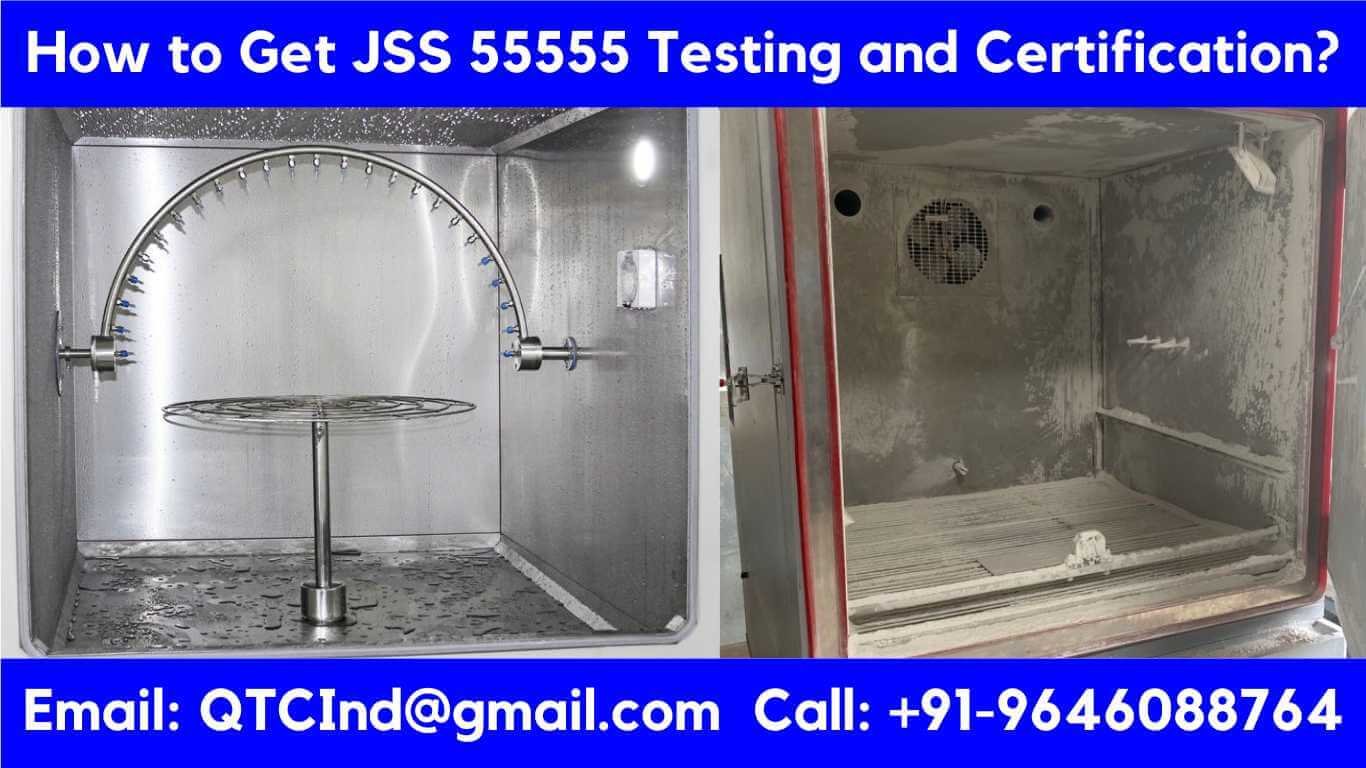
- Dust Test
- Vibration Test
The primary purpose of JSS 55555 is to determine the resistance of electronic and electrical equipment against mold growth. This standard ensures product reliability and performance in challenging environmental conditions.
How to get JSS 55555 Testing and Certification?
To get JSS 55555 testing and certification, you would typically follow these steps:
- Identify a Testing Laboratory: Find a laboratory that is equipped to perform JSS 55555 testing. These laboratories should have the necessary equipment and expertise to carry out the tests as per the JSS 55555 2012 standard.
- Submit Your Product: You would need to submit your product or material to the testing laboratory for evaluation.
- Perform the Tests: The laboratory will perform the necessary tests as per the JSS 55555 standard. This could include tests for dry heat, cold, damp heat, dust, vibration, shock and bump, and composite temperature humidity.
- Receive the Results: Once the tests are completed, the laboratory will provide you with a report detailing the results. If your product or material meets the requirements of the JSS 55555 standard, you will receive a certification.
- Technical Approval: Technical approval for various tests to be carried out is approved by CQAE(WE) Bangalore in consultation with DQA(N) HQ on a case-to-case basis, depending upon the specification and end user requirement as laid down in the Purchase Order.
How long does it take to complete a JSS 55555 test?
The duration of a JSS 55555 test can vary significantly depending on the specific test method. Here are some general guidelines:
- Dry Heat Test, Cold Test, Damp Heat Test, Dust Test, Vibration Test, Shock and Bump Test, and Composite Temperature Humidity Test: The duration for these tests can vary based on the specific requirements of the equipment being tested.
- Conditioning: This involves maintaining a temperature of 20°C to 40°C and 95% RH to 98% RH. The pressure is maintained at 200 kPa with 4/8 nozzle spray for 1 hour.
Please note that these are just a few examples of the many different types of tests included in the JSS 55555 standard. Each test has its specific procedures and durations. It’s also important to remember that the actual duration can vary based on the specific requirements of the equipment being tested
What is the purpose of JSS 55555?
JSS 55555, also known as “Penta-Five,” is a military standard used by the Indian Armed Forces for the selection and evaluation of electronic components used in military applications. It is primarily used to determine the resistance of electronic and electrical equipment against mold growth.
The standard includes a variety of environmental test methods for electronic and electrical equipment. These tests are designed to ensure that the equipment can withstand harsh environmental conditions and continue to function effectively. The main aim of standardization in defense is to reduce the existing inventory without affecting the preparedness/efficiency of the Defense Forces.
In conclusion, the JSS 55555 standard is an important tool for ensuring that products meet safety and environmental requirements. By adhering to this standard, companies can ensure they are providing safe and reliable products while meeting all applicable federal regulations
What is the JSS 55555 test for Mould growth?
The JSS 55555 test for mold growth, also known as the antifungal test, is used to determine the resistance of electronic and electrical equipment against mold growth. This test is particularly important for products that may be exposed to environments with high humidity, moisture, and poor ventilation, where mold and fungus can thrive.
The test typically involves placing a sample of the product or material to be tested in a growth medium that is designed to promote fungal growth. The sample is then incubated under controlled environmental conditions of temperature and humidity for a specified period, typically several weeks, to allow the fungi to grow. After the incubation period, the sample is examined for the presence and extent of fungal growth, and the type of fungus can be identified.
This test is commonly used in industries such as electronics, aerospace, automotive, and construction to ensure that products and materials are not susceptible to fungal growth, which could impact their performance and longevity. It is also used in indoor air quality testing to determine if mold is present in the air or on surfaces, which could cause health problems for occupants of a building
What is the JSS 55555 Testing Cost?
The cost of JSS 55555 testing can vary significantly depending on the specific tests required, the complexity of the equipment being tested, and the testing laboratory’s pricing structure.
For government agencies where supply orders have been placed by the Ministry of Defence (MoD), Indian Head Quarters (IHQ), Defence Research and Development Organisation (DRDO), shipyards, and where the Directorate General of Quality Assurance (DGQA) has been assigned the responsibility of Inspecting Agency/Inspecting Officer, the testing is undertaken free of cost.
However, for commercial entities, there would be a cost involved. It’s recommended to reach out to the testing laboratories directly for a more accurate quote12. Please note that the cost can also be influenced by factors such as the time required for testing, the number of test cycles, and the complexity of the test setup
Can you give me an example of a product that has passed JSS 55555 testing?
Sure, here are some examples of products that have passed JSS 55555 testing:
- Power products: This includes UPS, SMPS, and Power Supplies.
- IT products: Examples include 2D Barcode Scanner, Multifunction Printers, Synchronous Multiplexer, Laptops, and portable tablet computers.
- Defense / Air Force / Navy products: These are prototype products that are often subjected to JSS 55555 testing.
These products have undergone rigorous testing under the JSS 55555 standard to ensure they can withstand harsh environmental conditions and continue to function effectively
Free download JSS 55555 Standard latest version 2012 in pdf format
What is the difference between JSS 55555 and MIL STD?
JSS 55555 and MIL-STD are both standards used for testing military products, particularly electronic and electrical equipment. They have stringent testing requirements that a material must pass for global military markets. Here are some key differences between them:
- Purpose: JSS 55555 is primarily used to determine the resistance of electronic and electrical equipment against mold growth. On the other hand, MIL-STD provides a series of tests to simulate different environmental conditions to check the durability and performance of the equipment.
- Adoption: JSS 55555 has been specifically designed to be more easily adopted by commercial entities, while MIL-STD is a much more comprehensive standard that covers a wider range of topics.
Both standards ensure that the products can withstand harsh environmental conditions and perform reliably. However, the choice between JSS 55555 and MIL-STD would depend on the specific requirements and the nature of the product being tested
What is the difference between JSS 55555 and MIL-STD-810?
JSS 55555 and MIL-STD-810 are both standards used for testing military products, particularly electronic and electrical equipment. They have stringent testing requirements that a material must pass for global military markets. Here are some key differences between them:
- Purpose: JSS 55555 is primarily used to determine the resistance of electronic and electrical equipment against mold growth. On the other hand, MIL-STD-810 provides a series of tests to simulate different environmental conditions to check the durability and performance of the equipment.
- Adoption: JSS 55555 has been specifically designed to be more easily adopted by commercial entities, while MIL-STD-810 is a much more comprehensive standard that covers a wider range of topics.
Both standards ensure that the products can withstand harsh environmental conditions and perform reliably. However, the choice between JSS 55555 and MIL-STD-810 would depend on the specific requirements and the nature of the product being tested.
What is the purpose of MIL-STD-810?
MIL-STD-810 is a United States Military Standard that emphasizes tailoring an equipment’s environmental design and test limits to the conditions that it will experience throughout its service life1. It establishes chamber test methods that replicate the effects of environments on the equipment rather than imitating the environments themselves.
The standard addresses a broad range of environmental conditions that include: low pressure for altitude testing; exposure to high and low temperatures plus temperature shock (both operating and in storage); rain (including wind-blown and freezing rain); humidity, fungus, salt fog for rust testing; sand and dust exposure.
The purpose of MIL-STD-810 is to ensure the operability of equipment in conditions it may come across during its service life. It provides a broad selection of environmental factors and tests to go with them, allowing companies to find any weak points and make the necessary changes. Following this standard, helps to improve the reliability and robustness of their product, resulting in successful harsh environment operation and a longer life in the field.
Although prepared specifically for U.S. military applications, the standard is often applied for commercial products as well. It serves as a useful tool for manufacturers, guaranteeing that their products can withstand the toughest circumstances
How long does it take to complete a MIL-STD-810 test?
The duration of a MIL-STD-810 test can vary significantly depending on the specific test method and the system category. Here are some general guidelines:
- Humidity Testing: This can take quite a while – between 15 and 180 days based on the system category, the humidity cycle, and whether conditions are natural or induced.
- Vibration Testing: Durations are either equivalent to a complete system/subsystem test, long enough to check material function, or an arbitrarily short time (5 or 10 minutes).
- Temperature Testing: The duration for this test can vary. For instance, the temperature shock test, which determines whether the power supply can sustain and withstand sudden temperature changes, defines “sudden temperature changes” as changes greater than 10°C (18°F) over one minute.
Please note that these are just a few examples of the many different types of tests included in the MIL-STD-810 standard. Each test has its specific procedures and durations. It’s also important to remember that the actual duration can vary based on the specific requirements of the equipment being tested.
What are the Requirements of JSS 55555 Testing and certification?
To get JSS 55555 testing and certification, the following requirements are typically needed:
- Product Submission: The product or material to be tested must be submitted to the testing laboratory.
- Test Performance: The necessary tests as per the JSS 55555 standard will be performed. This could include tests for dry heat, cold, damp heat, dust, vibration, shock and bump, and composite temperature humidity.
- Documentation: Certain documents may be required, such as Income Tax Assessment Completion Certificates for the last three financial years, a copy of the PAN card, Certificate of Registration for GST, performance certificates from past and present clients, experience certificates for the same or similar kind of testing, and a copy of the NABL accredited certificate.
Please note that the specific process and requirements can vary depending on the testing laboratory and the nature of the product or material being tested. It’s recommended to reach out to the testing laboratory directly for more specific information
If your buyer or client demands JSS 55555 testing and certification, or if you have to participate in any tender and you need a JSS 55555 test report, then you can contact us. Our laboratory is fully equipped with testing experts and is government-approved. We are providing JSS 55555 testing and certification services in India and all over the world. If you have any requirements for the same, you can feel free to contact us by email at QTCInd@gamil.com, WhatsApp